
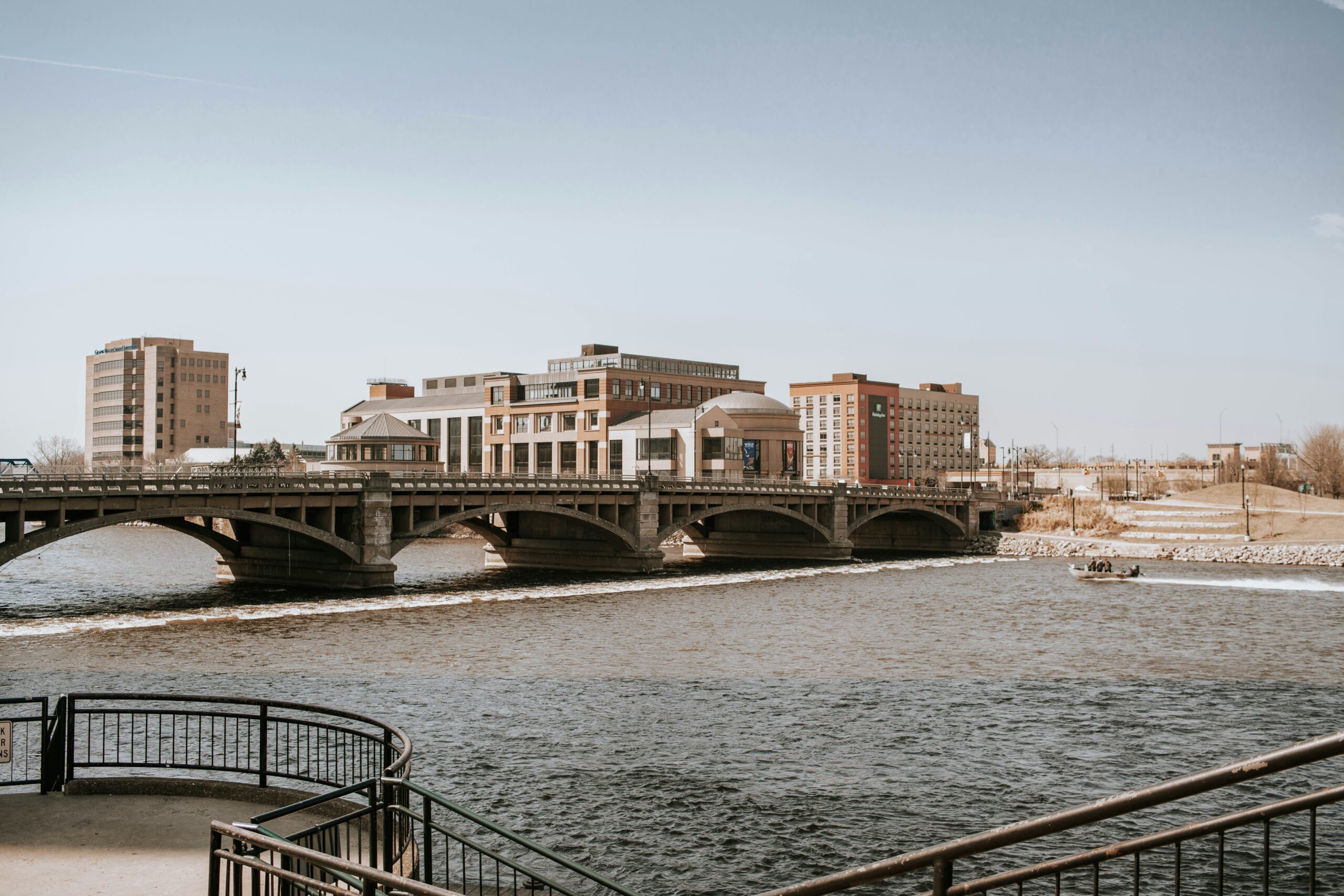
If you look at Grand Rapids on a macro level, the data tells a beautiful story. Rents are stable, the job market is diversified, and the population is growing. But if you try to underwrite Kent County as a single monolith, you’re setting yourself up for a very expensive lesson. Opportunity hasn’t disappeared from West Michigan—it has just become hyper-localized and requires different approaches for different assets.
Buying a century-old, balloon-framed duplex over on the West Side requires a completely different playbook than managing a 1970s split-level out in Wyoming. When our team analyzes local submarkets for our own portfolios and our clients, we don’t just look at spreadsheets—we look at the actual street-level reality. Here is how the market splits right now.
1. The Institutional Core: Medical Mile, Belknap, & Heritage Hill
This is your “sleep at night” real estate. If your thesis relies on long-term appreciation and strong tenant profiles, staying tight to the downtown healthcare grid is the best bet. Between Corewell Health, MSU’s college of human medicine, and Van Andel, this pocket is permanently flooded with high-earning medical residents, traveling nurses, and researchers. Structural vacancy here is practically non-existent. Local agent Chris Timmer, of KW Rivertown, echoed this sentiment, noting that these neighborhoods are attractive to both investors and owner-occupiers largely due to their proximity to job opportunities.
Rents vary depending on the specific location, quality, and features of the property. However, the market currently site at the following ranges:
- Small Multifamily (Belknap / Midtown): Clean 1- and 2-bedroom units are commanding anywhere from $1,450 to $2,100. This is prime territory for house-hackers or investors who prioritize a high-quality tenant base over raw cash-on-cash return.
- Single-Family (Fulton Heights / Highland Park): Solid 3-bedroom character homes sit comfortably in the $2,000 to $2,500+ range.
2. The Sweat-Equity Corridor: Creston & The West Side (SWAN)
If you’re looking for immediate yield and you aren’t afraid of a lengthy property inspection report, this is can be an attractive opportunity.
Creston is dense with early 20th-century duplexes. Updated 2-beds are renting for $1,500 to $1,800, and a decent 3-bed single-family can clear $2,100. The playbook here isn’t rocket science: find a property with legacy rents trailing actual market rates by $400, systematically update the older mechanicals, kitchens, interiors, etc. and capture the spread.
Over on the West Side, particularly the SWAN and West Grand neighborhoods, the commercial velocity along Bridge and Michigan Street keeps rental demand intense. Small multifamily units are averaging $1,450 to $1,700. The major benefit here is appreciation. With the new soccer stadium under construction and new businesses being founded on Bridge St, there is a strong case for economic growth in the neighborhood. In the long run, this will translate into improved rents and increased property values.
3. The Quiet Cash Cow: Wyoming & Kentwood
Downtown gets all the attention, but if you just want predictable cash flow without a revolving door of tenants, look just south of the city limits, specifically suburban single-family rentals in Wyoming and Kentwood. A typical 3-to-4-bedroom ranch or split-level rents smoothly between $1,800 and $2,500+.
The real attraction here is tenant retention. While a 1-bedroom apartment in Midtown turns over almost every 12 to 24 months as young professionals move or buy homes, families renting houses in these suburbs easily stay for 3 to 5+ years. They want the yards, they want the attached garages, and they don’t want to move their kids out of the school district. Plus, handling a 1970s build with modern PVC plumbing means far fewer midnight emergency calls than you’ll ever get with a 1910 West Side duplex.
The Math Everyone Ignores: The True Cost of a Move-Out
The numbers are hard enough as it is in today’s market. Asset prices are elevated and it is becoming increasingly difficult to underwrite new investments. That makes it especially crucial to remain disciplined in evaluating new opportunities.
When investors review pro-formas, the first thing to look at is the vacancy assumption. They almost always plug in a generic 5%. That’s a spreadsheet fantasy. In the real world, turnover is the absolute silent killer of real estate returns. Let’s look at what actually happens when a tenant vacates an $1,800 single-family home:
- The Vacancy Gap: It takes an average of 35+ days to clean, market, screen, and sign a new lease. That’s roughly $2,100 in lost top-line revenue.
- The Turn: Even a clean tenant leaves scuffs. By the time you patch drywall, do a full paint touch-up, deep clean the carpets, and fix the minor plumbing leaks you didn’t know about, you’re looking at $2,450 in maintenance costs.
- Leasing Fees: Marketing, showings, and tenant screening run about $1,500.
That single, standard move-out just cost you $6,050 out of pocket.
If you own a duplex and both sides turn in the same 12-month cycle, you are bleeding over $12,000 in pure friction. Suddenly, a great investment on paper is a break-even headache.
The most successful investors don’t squeeze their tenants for an extra $50 a month at renewal just to trigger a move-out. They prioritize fast maintenance response times and fair renewals because keeping a property occupied beats chasing nominal rent increases every single time.