
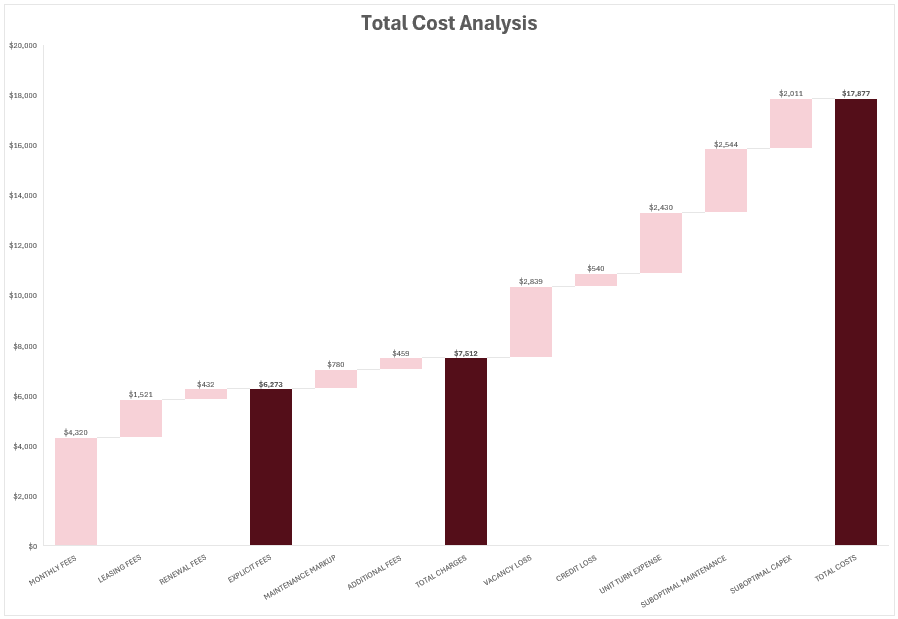
Ask five real estate investors in Grand Rapids or greater West Michigan how they evaluate a property manager, and four of them will instantly quote you top-line percentages: Is the monthly management fee 6%, 8%, or 10%? Is the leasing placement fee half a month’s rent or a full month? Evaluating a management partner strictly by their base fee is the single fastest way to bleed cash flow on a residential or small multifamily asset.
The standard contract line item is just the tip of the iceberg. The real cost of managing property isn’t what shows up on your monthly invoice—it is what quietly leaks out of your Net Operating Income (NOI) through sluggish turn schedules, lazy vendor management, loose tenant screening, and uncaptured market rent.
When you look closely at owner statements and P&Ls across West Michigan, the math tells a clear story: low-fee, reactive management is extraordinarily expensive.
1. The Financial Reality of a Slow Turn
Vacancy is the single largest unbilled expense on your income statement. While many landlords write turnover off as an inevitable market condition, in residential rentals, high vacancy is almost always a sign of operational friction. When a traditional management team treats maintenance as an administrative nuisance or ignores resident communication, qualified tenants leave. Every turn hits your bottom line in three distinct ways:
- Direct Physical Turn: Paint, deep cleaning, lock rekeys, and basic make-ready work typically sit between $2,000 and $3,000 per door.
- Administrative Overhead: Marketing, running showings, vetting applications, and lease execution.
- The Vacancy Window: An organized maintenance crew with tight vendor relationships can turn a standard unit in 10 to 15 days or less. Unorganized workflows—chasing contractors, delaying make-ready inspections—stretch that window to 45 days or more.
Those extra 30 days of empty space aren’t just lost rent; they are pure, unrecoverable cash flow loss. In a portfolio averaging a 45-day turn cycle, you can easily burn 5% to 10% of your gross potential revenue every single year.
2. Bad Screening and Weak Collection Workflows
Rent collection issues rarely begin on the 1st of the month—they begin during the application process.
Subpar management practices often prioritize filling units quickly over vetting thoroughly. Cutting corners on income verification, credit history, background checks, and landlord references inevitably leads to delinquency. When non-payment occurs, reactive managers respond with loose enforcement, letting late balances compile for weeks before taking formal action.
- Disciplined Screening: Keeps credit loss and bad debt under 1% of gross potential revenue through rigorous screening frameworks and immediate, structured collection workflows.
- Reactive Management: Lets uncollected rent, unpaid utility kickbacks, and bad debt write-offs creep up to 3% or higher.
That 2% difference drops directly off your bottom line.
3. The Hidden Surcharges in Reactive Maintenance
Maintenance is often viewed as unpredictable, but it doesn’t need to be a constant series of unexpected emergencies.
A reactive management model operates strictly on defense: waiting for a resident to submit a work order for a leaking pipe or failing furnace, then dispatching standard third-party contractors at retail rates. This erodes your operational return in three areas:
- Third-Party Markups: Traditional management agreements routinely tack on a 10% to 15%+ surcharge on top of third-party vendor invoices. Rather than seeking cost-efficiency, the manager profits off your repairs.
- Shortened Asset Lifespans: Skipping an annual HVAC check feels like saving money—until the unit burns out four years early, forcing an unexpected $7,000 emergency replacement. Neglect across plumbing systems, water heaters, and roofs quickly destroys your CapEx strategy.
- Compounded Secondary Damage: A minor plumbing issue that sits unaddressed for a week turns into dry rot, ruined subfloors, and mold remediation. What should have been a simple service call turns into a multi thousand-dollar restoration project due to slow execution.
4. CapEx Planning Requires a Long-Term Horizon
Capital expenditures preserve your asset’s long-term value and keep your units competitive in the Grand Rapids rental market. Reactive management handles CapEx in two destructive ways: emergency replacements or total deferral.
Replacing a roof or water heater on an emergency basis means paying premium emergency labor rates with zero opportunity to solicit competitive bids. Conversely, deferring exterior maintenance or allowing common spaces to deteriorate lowers resident satisfaction, attracts underqualified applicants, depresses achievable rents, and ultimately drags down appraised asset value.
Proactive asset stewardship models capital needs over a decade. By forecasting when mechanical systems and roofs will reach the end of their useful service lives, you can group capital work, negotiate vendor pricing, and fund reserves predictably.
5. Unchecked Operating Expense Leakage
Controllable operating expenses go far beyond resident service calls. Reactive managers routinely allow seasonal contracts—like snow removal and lawn care—to auto-renew year after year without re-bidding the scope of work. In West Michigan, where seasonal weather swings heavily impact property operations, vendor pricing for identical scopes can vary by 20% to 40%.
Unmonitored utilities are another quiet drain. A sudden jump in a water bill almost always points to a running toilet or an undetected subfloor leak. Approving utility invoices without auditing month-over-month variance lets hundreds of dollars leak out unnoticed.
6. Rent Optimization: Leaving Real Value on the Table
While controlling expenses is essential, performance-driven management is equally about capturing top-line potential. Reactive managers frequently default to flat-rate renewals because auto-renewing at existing pricing requires less operational effort than executing hyper-local market analyses.
Rental rates in Grand Rapids are hyper-local—often varying block by block. Pricing an updated door even $150 below true market value costs an owner $1,800 a year in uncaptured income.
Because real estate values are driven directly by Net Operating Income (NOI), that uncaptured revenue directly impacts your equity. At a 6% capitalization rate, every $1,000 in lost annual NOI represents roughly $16,600 in erased property value.
True Alignment vs. Management Fees
The fundamental flaw in traditional property management is misaligned incentives. When a management company profits off tenant turnover (via repeat placement fees), administrative markups on vendor invoices, and flat monthly fees regardless of performance, they have zero financial incentive to keep long-term residents in place or keep repair costs down.
True property management shouldn’t just be administrative—it should function as asset management.
When selecting a partner to manage your real estate portfolio, look for structural alignment that protects your long-term returns:
- Transparent Pricing: No hidden markups on maintenance invoices or third-party vendor work.
- Retention-Focused Operations: Workflows built around high resident satisfaction, quick turnarounds, and proactive lease renewals.
- Preventative Maintenance Routines: Scheduled seasonal inspections to resolve minor issues before they become emergency CapEx events.
- Active Expense Auditing: Ongoing auditing of service contracts, utility variances, and long-range capital planning.
The lowest fee percentage on paper is rarely the most profitable management choice. Real returns come from disciplined, performance-aligned execution that protects top-line revenue, controls operating expenses, and drives compounding equity over time.